
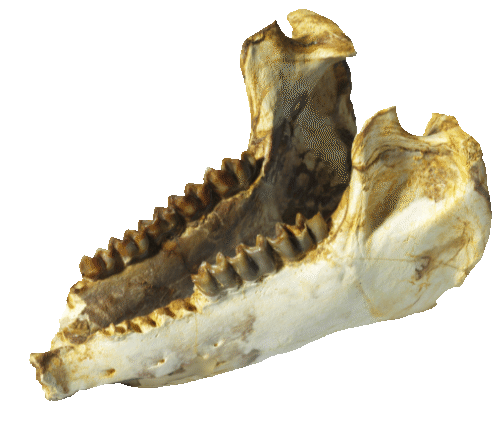
May 2026: Lower jaw of ancient horse


Lower jaw of ancient horse
Plagiolophus minor (Cuvier, 1804)
SNSB-BSPG 1969 XIII 178
Neogene: Late Eocene, ca. 39 million of years
Möhren 6 near Treuchtlingen, Middle Franconia, Germany
Every child knows horses, zebras, and donkeys. With their long limbs, each ending in a single toe, and their molars with extremely high crowns, they are perfectly adapted to life in open grasslands. Due to their close kinship, they are grouped together in the genus Equus in biological systematics and are the only living representatives of the in deep time extremely diverse group of horses (Equoidea).
Among the many extinct horses, the palaeotheres in particular differ greatly from their modern relatives. They lived 48 to 33 million years ago, from the Middle Eocene to the Early Oligocene, primarily in Europe, which at that time was a subtropical archipelago. Unlike modern horses, palaeotheres had proportionally shorter limbs, each with three toes, and a dentition featuring low-crowned molars. This made them ideally adapted to their habitat in the archipelago’s rainforests and a diet of abundant leaves and fruits. Their body sizes varied considerably; while the smallest were no larger than a French Bulldog (10 kg, shoulder height 30 cm), the largest exceeded the dimensions of the South American tapir (320 kg, shoulder height 110 cm). Palaeotheres were originally thought to resemble tapirs, and there was even speculation that they had a trunk. However, modern research supports the idea that they had a slimmer body shape and lacked a trunk.
The extinction of the palaeotheres coincided with the so-called “Grande Coupure,” a major biodiversity crisis at the transition from the Eocene to the Oligocene 34 million years ago. This event was triggered by significant climatic changes, including a temperature drop of up to 6 °C, during which ice sheets formed at the poles and sea levels fell worldwide. As a result, terrestrial habitats not only changed but also expanded, creating land bridges to Asia across which competing mammal species migrated. While most palaeotheres species went extinct during this crisis, the genus Plagiolophus survived into the early Oligocene.
The Fossil of the Month is a lower jaw of Plagiolophus minor, a small palaeothere species. The jaw was recovered in 1969 from a karst fissure in Middle Franconia. Compared to modern horses, the jaw of Plagiolophus is shorter and has less attachment surface for the masticatory muscles. This is related to the softer, more nutritious, and easier-to-digest diet of the palaeotheres, which could be processed even without extreme adaptations in the masticatory apparatus. The marbled coloring of the jaw resulted from varying degrees of mineralization during the fossilization process.
Manon Hullot (Jurassica Museum Switzerland), Gertrud E. Rössner (SNSB-BSPG München)