
July 2026: Hyoliths


Slapylites signatulus (Novák, 1891)
Paleozoic: Middle Cambrian, approx. 510 million years old
Skryje, Czech Republic
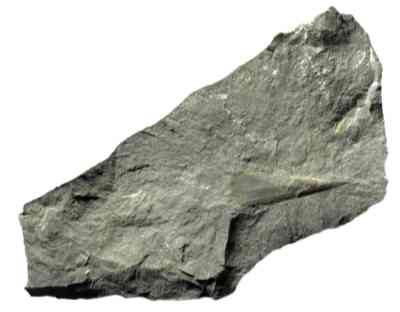
Slapylites signatulus (Novák, 1891) from middle Cambrian deposits
of Skryje in Bohemia (Czech Republic). Scale: 1 cm.
With the “Cambrian Explosion” – that phase approximately 540 million years ago during which animal life on Earth rapidly diversified – small, cone-shaped animals emerged: the hyoliths. Their calcareous shells, ranging in length from about one to several centimetres, consist of three parts: an elongated, tapering main shell (formerly referred to as the “conch”), a lid (operculum) that sealed the opening, and – at least in one group – two curved supporting rods known as “helens”. This name was coined as early as 1890 by Charles D. Walcott, who originally regarded these structures as distinct fossils; he classified them as relatives of the tusk shells (Scaphopoda, a class of molluscs) and called them Helenia.
Hyoliths lived exclusively in marine environments, likely dwelling benthically upon the sediment. It is believed that they used their helens to prop themselves up, thereby keeping the shell’s opening elevated above the seafloor. Some hyoliths have also been discovered in an upright position, suggesting a sessile lifestyle. Hyoliths fed on organic particles – though whether they functioned as filter feeders or detritivores remains a matter of ongoing debate.
The precise placement of hyoliths within the tree of life was a subject of long-standing controversy. Today, the prevailing consensus is that they belong to the Lophotrochozoa – a major clade that also encompasses molluscs, annelids, and brachiopods. Hyoliths first appeared in the Early Cambrian, achieved a worldwide distribution, and went extinct at the end of the Permian period, approximately 252 million years ago, marking a success story spanning nearly 300 million years. They were a particularly abundant group during the Cambrian; from that period alone, over 115 genera have been described.
The present fossil, Slapylites signatulus (Novák, 1891), belongs to the family Slapylitidae within the order Hyolithida. Characteristic features of this family include an operculum bearing clavicles, as well as the absence of supporting rods. This specimen was discovered near Skryje in Bohemia, today part of the Czech Republic. During the middle Cambrian, this region was situated along the northern margin of the supercontinent Gondwana, within a shallow, warm, tropical sea. The sediments of Skryje have yielded an astonishingly diverse fauna, including trilobites, brachiopods, and early echinoderms – offering a window into a marine landscape that was still utterly alien to our modern world.
Thomas A. Neubauer, Munich
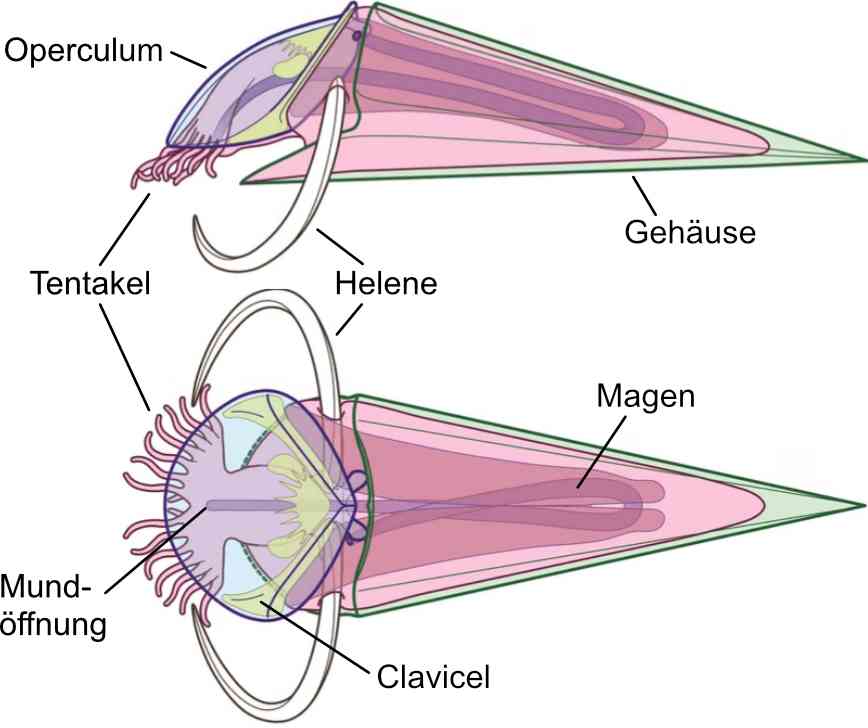
Reconstruction of the hyolith genus Haplophrentis from the middle Cambrian of North America. The helens are rotated downward to support the body. After Moysiuk et al. (2017, Nature); illustration © Danielle Dufault, Royal Ontario Museum.