
August 2026: Stem of a horsetail


Equisetites arenaceus (Jaeger) Schenk
Werksandstein, Lower Keuper, Late Triassic (c. 220 million years ago)
Ermetzhofen, east of Uffenheim, Middle Franconia, Germany
Length of fossil: c. 58 cm
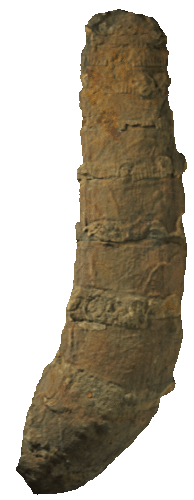
This month’s fossil is an impressive specimen from our Old Collection, which was first scientifically described by K.E. von Schafhäutl as early as 1865. It is the lower part of a stem from a horsetail of the genus Equisetites Sternberg. This predominantly Mesozoic (Triassic–Cretaceous) genus included plants whose appearance resembled modern horsetails, but some of which reached impressive heights of up to 6 m; the largest modern horsetails grow to barely more than 2–3 m in height. Equisetites plants consisted of underground creeping shoots (rhizomes) and upright, above-ground, unbranched or branched aerial shoots or stems up to 20 cm in diameter. The stems were regularly divided into nodes and the internodes between them – a characteristic feature of all horsetails (Sphenophyta). At each node, Equisetites bore a whorl of small leaves that were fused together at the sides, forming a leaf sheath that encircled the node like a cuff; such leaf sheaths are still partially preserved in the upper part of our fossil. It is also clearly visible that the stem produced roots or branches in an irregular pattern, the rounded attachment points of which are still preserved.
Photo: Stem of a horsetail
Our Fossil of the Month belongs to the species Equisetites arenaceus (Jaeger) Schenk, arguably the best-known representative of the genus Equisetites from the Upper Triassic of central Europe. The stem is preserved as a combination of a three-dimensional cast (Steinkern) and an impression: the interior of the stem, which was hollow during the plant’s lifetime, filled with sediment after its death, and this filling, which turned to stone over time, has been preserved as a cast following the decay of the organic material. Parts of leaf sheaths are preserved as impressions on the surface of the cast. Equisetites arenaceus was one of the largest members of the horsetails in Mesozoic Europe. However, this plant could hardly match the stature of its Carboniferous relatives, the calamites, of which stems with diameters exceeding 50 cm are known and some of which reached heights of more than 20 m.