
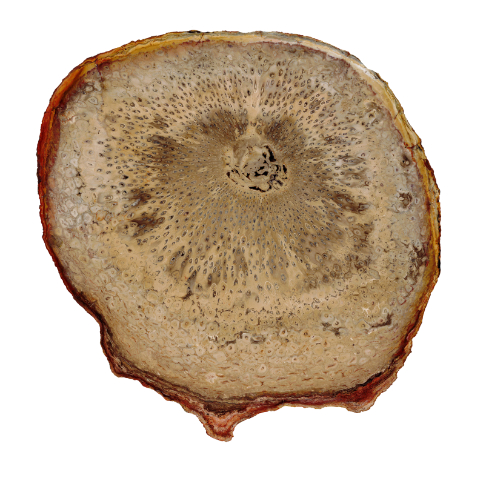
November 2026: Segment (slice) of a tree fern trunk, cross section


Tietea singularis (Solms-Laubach) Herbst
Lower Permian (c. 278 Ma)
Pedra de Fogo Formation, Araguaína, Tocantins, Brazil
Trunk diameter: c. 18 cm
Petrified trunks of tree ferns of the genus Psaronius (Marattiales, Psaroniaceae) from the European Carboniferous and Permian have been our ‘Fossil of the Month’ on several occasions. The specimen we have chosen as this month’s ‘Fossil of the Month’ demonstrates that impressive tree-fern fossils have also been found on other continents.
Particularly well-preserved tree fern trunks come from Permian deposits in northern and northeastern Brazil. Some of them resemble the European Psaronius trunks, while others differ markedly from them. As early as 1913, Hermann Graf zu Solms-Laubach described such differences and introduced the new genus Tietea for some trunks that differed from Psaronius. Our ‘Fossil of the Month’ for November is a cross section of a stem of Tietea singularis, the type species of this genus, from the Lower Permian of the Estado do Tocantins in Brazil.
Tietea tree ferns could reach heights of up to 15 meters, and their trunks measured up to 1.2 meters in dimeter at the base. Our fossil shows clearly how the trunk was constructed: In the center of the slab, one can see the actual trunk, which consists of many small vascular bundles embedded in a ground tissue. In Tietea, these bundles are short and broad in cross-section, and usually C- or V-shaped, whereas in Psaronius they are more elongated. In addition, the cross-section of Tietea stems changes from a more or less circular shape to a square one as they extend towards the tip. Like Psaronius, Tietea also had a root mantle surrounding the actual stem consisting of individual roots that extended from the trunk along nearly its entire length and grew downward into the soil. This made the root mantle much thicker at the base of the trunk than higher up. The roots helped the plant absorb water and nutrients and provided stability. Many modern tree ferns possess similar root mantles, demonstrating that this architectural principle is a long-standing and successful invention of nature.
At some sites in Brazil, remains of Tietea singularis account for nearly 90% of the fossil finds, suggesting that this tree fern dominated certain habitats in the Southern Hemisphere during the early Permian and was highly successful. Tietea and Psaronius provide important insights into the diversity of marattialean ferns in the late Paleozoic and into the evolution of trunk architectures in tree ferns.