
October 2026: Trilobite


Coronocephalus sp.
Fentou Formation, Llandovery (Telychian, approx. 435 million years ago), south of Wuhan (Central Chin
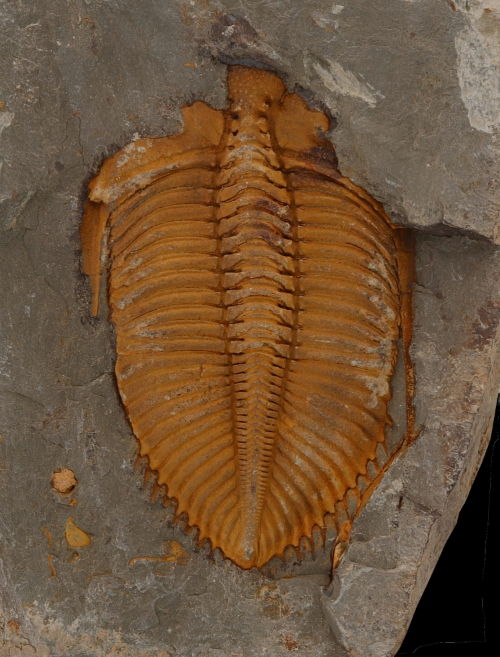
Trilobites—named for the three-lobed division of their bodies—belong to an extinct group of marine arthropods that existed worldwide from the Early Cambrian to the Late Permian (540–250 million years ago). A characteristic feature of trilobite fossils is the presence of a dorsal exoskeleton. In almost all trilobites, the structural framework of protein and chitin is impregnated with calcium carbonate. Elements of the underside of the body—such as biramous (branched) limbs or internal organs—are rarely preserved. Depending on the number and configuration of body segments, the exoskeleton was articulated, allowing the animal to fold or even roll up to protect its soft tissues. Adapted to various lifestyles—whether burrowing in sediment, living on the seafloor, swimming freely in the water column, or inhabiting reef environments—trilobites included proficient swimmers, sediment burrowers, blind forms, and species with compound eyes. Like all arthropods, trilobites had to molt repeatedly before reaching adulthood. Consequently, most preserved trilobite fossils are not the actual carcasses of the animals, but rather their discarded exoskeletons (exuviae). Due to their relatively short geological ranges, wide distribution, and occurrence within specific faunal provinces, many species serve as excellent index fossils for the period spanning the Cambrian to the Early Carboniferous. Trilobites were the dominant marine arthropods of the Paleozoic Era.
Fig.: Trilobite Coronocephalus sp. from the Silurian (Fentou Formation) of Wuhan, Central China; approx. 435 million years old. Fossil length: 7 cm. Inv. no. SNSB-BSPG 2014 XXV 1629. Photo: SNSB-BSPG/Imelda Hausmann.
The Coronocephalus specimen presented here originates from the upper Fentou Formation, south of Wuhan, Central China. This rock formation—which, in its southern distribution area, consists of gray-green or dark gray, very fine-grained limestones (“mudstones”)—yields various marine fossils and trace fossils collectively known as the Fentou biota. These include numerous trilobites as well as other arthropods (phyllocarids), echinoderms, cnidarians, brachiopods, bivalves, and sponges. Sediments and fauna indicate that the habitat was located in a shallow sea, situated below or within the zone of wave base.
The specimen is part of the Helmut Keupp Collection (Berlin), which was acquired for the Munich State Collection by the Free State of Bavaria in 2014, with the support of the local friends’ association. The collection comprises primarily cephalopod fossils, but also includes other fossil groups—such as corals, bivalves, and arthropods—from various regions and geological eras. It represents one of the most significant additions to the Munich State Collection in decades. The trilobite was a gift presented to Prof. Keupp by the Academia Sinica in Nanjing in 2010, during one of his visits to China.
Martin Nose & Isabell Bommer, Munich