February 2026: Sea spider


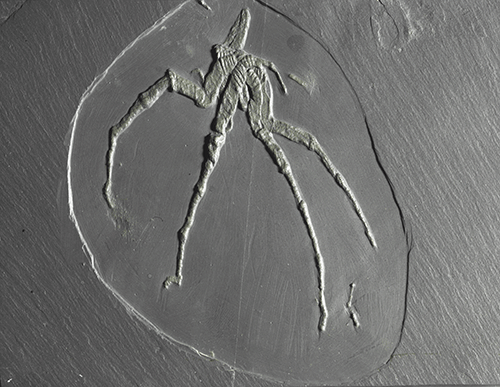
Sea spider
Palaeopantopus maucheri BROILI, 1929
Lower Devonian (Emsian, approx. 400 million years ago)
Hunsrück Slate, Bundenbach in the Hunsrück,
Rhineland-Palatinate
Size of fossil: approx. 9.5 cmnew text
Sea spiders – scientifically known as Pycnogonida – belong to the chelicerates, which also include arachnids. The name sea spider is misleading, as they are no spiders. However, almost all species known today have four pairs of walking legs, like true spiders. They also have chelicerae, which inject venom in spiders but are shaped like pincers in the non-venomous sea spiders. The most striking feature of sea spiders is that they consist almost entirely of legs, with their actual body being greatly reduced in size. Even some of their organs extend into their extremities, as their body does not offer enough space for them. They have a proboscis, which they use to feed. Their diet consists mainly of marine animals (including bryozoans, sponges, snails and coral polyps) that live sessile on one place or move very slowly, as sea spiders are sluggishly moving animals. Interestingly, the males take care of the brood. To do this, they use their so-called ovigera, specialised limbs, to pick up the females’ eggs and stick them there. The hatchlings remain there until they can live independently.
The fossil of the month belongs to the sea spider species Palaeopantopus maucheri and lived around 400 million years ago in the Lower Devonian period. The fossil comes from the world-famous Hunsrück Slate near Bundenbach (north of Idar-Oberstein, Rhineland-Palatinate), one of the historical centres of slate mining in the Hunsrück region. What is special about this region is the excellent preservation of the fossils. Through the fossilisation process, the former marine organisms were completely or partially transformed into pyrite. The preservation of fine structures is excellent and, thanks to the pyritisation, it is even possible to make body parts hidden in the sediment visible using X-rays. During the Lower Devonian, the former habitat consisted of a sea approximately 200 metres deep, which was inhabited by a large variety of organisms. Over 270 animal species have been described from the Hunsrück Slate so far, including various sea lilies, brittle stars and crustaceans. A total of five species of sea spiders are known from this locality. They were probably predators, but may also have fed on carrion. The walking legs of Palaeopantopus maucheri were long and slender, making them ideal for stalking across the sea floor. However, it has not yet been possible to determine whether this species was also capable of swimming.
Imelda M. Hausmann