

Morphology of the ammonite shell


The shape of the shell in ammonites is varied. Within the dominant flat spiral, a distinction is made between forms having a narrow or a wide umbilicius based on the degree of overlap of the whorls, between forms with high and low openings (apertures) based on the whorl cross-section, between disc-shaped and spherical forms etc. There is a trend that fewer and fewer ammonites with smooth shells appear in the course of time, while, at the same time, the proportional abundance of sculptured forms increased – probably in response to increasing pressure from shell-crushing, predatory crabs and fishes. Numerous species with ribs on their shells (resembling corrugated sheet metal) occurred in various evolutionary lineages, especially from the beginning of the Mesozoic (Triassic).
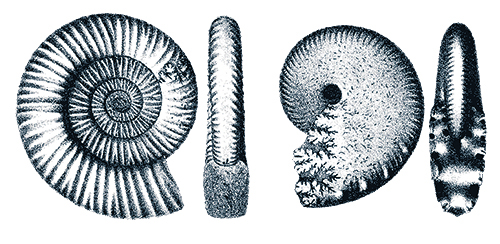
Figure1:
Two examples of different umbilical diameters in ammonite shells. Left: Subnebrodites (shell diameter 7 cm) with wide umbilicus, in which the younger whorls only slightly cover the former whorls (evolute). Right: Taramelliceras (shell diameter 6 cm) with narrow umbilicus, in which the younger whorls entirely cover the former ones (involute). From Quenstedt (1887/1888)
Species whose shells were reinforced with broad spines and other sculptural elements lived safely below the wave base because of the high resistance in the water, while smooth, streamlined shells appear to have mostly occurred in shallower agitated water. At times of particularly high sea levels (e.g. Late Triassic, Middle Jurassic), but especially during the Cretaceous, when the world sea level was more than 200 m above today’s level, so-called heteromorphs appeared. Their shell shape strongly deviated from the usual, closed planispiral shape, and numerous rather bizarre shapes are found during this time interval. Contrary to certain beliefs that heteromorphic ammonites represent aberrant forms whose gene pool is „exhausted“ and that represent harbingers of the extinction of the entire group, we today view these forms as food specialists, well-adaptated to still water conditions on the extensive shelf seas. They probably drifted more or less passively in the seawater.
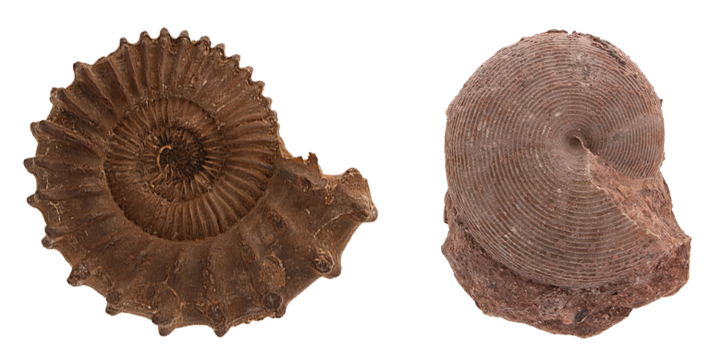
Figure2:
Left: Peltomorphites prieserae (Stephanov) – an evolute ammonite with strong ribbing and strong knots. Right: Agathiceras sundaicum (Haniel) – an involute ammonite with prominent spiral ridges
Figure 3 (In exhibition only)
Various shell structures of ammonite shells: e.g., nodes, spines, tubercles. From MOORE (Ed.): Treatise on Invertebrate Paleontology, Part L, 1957