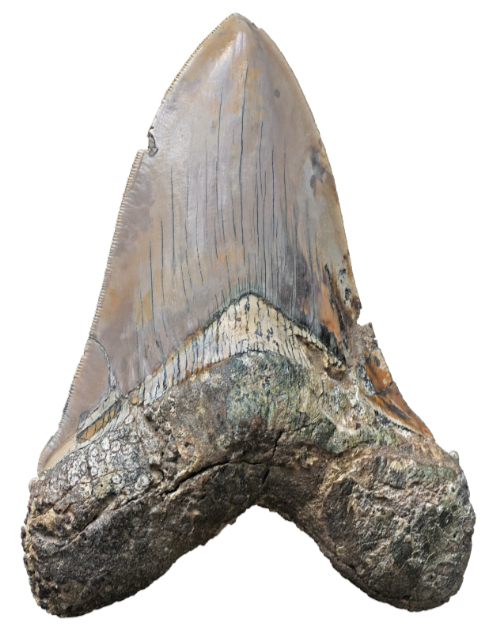
September 2026: Tooth of a giant shark Otodus megalodon (Agassiz, 1835)
Miocene, ca. 7 Million years
Ica Desert, Peru
Sharks (Elasmobranchii) are an ancient group of vertebrates that are known since at least the Devonian period (approximately 390 million years ago). Today, the group comprises rays (Batomorphi) and true sharks (Selachii), which inhabit the world’s oceans with over 1,000 species. Although one often reads or hears that sharks are “living fossils” that have barely changed over vast periods of time, this is not strictly accurate; numerous shark species from the geological past looked very different from modern sharks, and even the latter display a remarkable diversity of forms—ranging from hammerheads and whale sharks to the well-known great white shark, the largest carnivorous shark alive today, which can reach lengths of up to 5 meters.
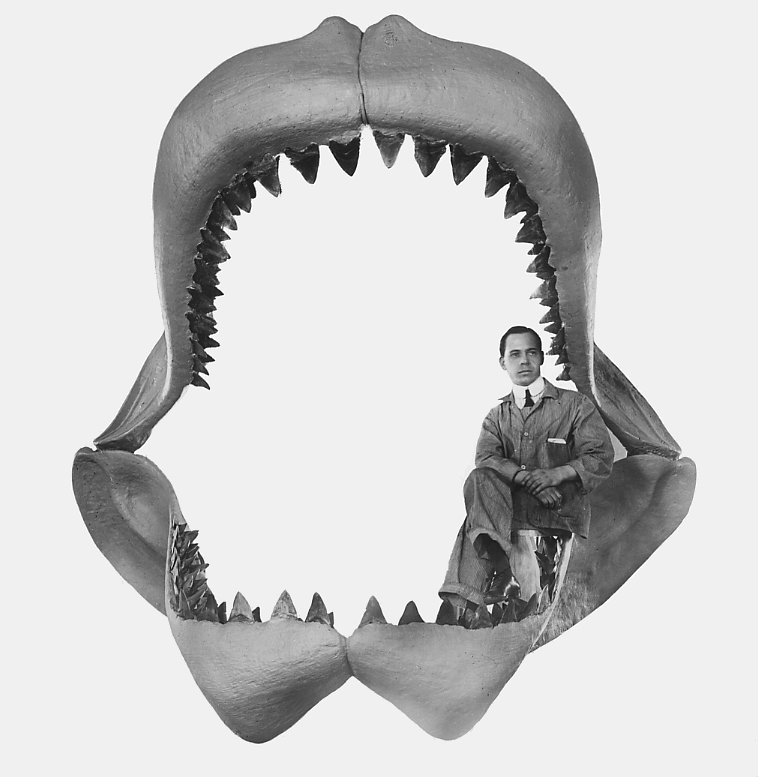
However, at a time that is relatively recent in geological terms—spanning from about 23 million to approximately 2.5 million years ago—there evidently existed a shark that was by far larger than the modern great white shark and may have even grown larger than the whale shark, which, at up to 19 meters in length, is the largest fish alive today. Teeth belonging to Otodus megalodon (its scientific name) have been found at numerous sites across Europe, North and South America, Africa, East Asia, Australia, and New Zealand, suggesting that these fish had a global distribution. Because these teeth closely resemble those of the modern great white shark, it was originally assumed that the species belonged to the same genus, Carcharodon; however, more recent studies suggest it was a member of the Otodontidae, an extinct group of sharks. Nevertheless, the shape of the teeth, bite marks found on whale bones, and the distribution of Otodus megalodon fossils indicate that these animals most likely shared a lifestyle very similar to that of the great white shark, acting as active hunters of other large vertebrates.
Since, apart from teeth, very few fossil remains of Otodus megalodon are known—as with all sharks, it was a cartilaginous fish, meaning its spine, skull, and fins were made of cartilage and thus did not preserve well as fossils—the question of its actual size has not yet been definitively settled. The most complete specimen known preserves a spinal column totaling 11 meters in length; however, the skull and tail fin are missing, leading to the conclusion that the total length was at least 16 meters. Based on these remains, an international team of researchers recently concluded that Otodus megalodon may have even reached lengths exceeding 24 meters.
P.S.: Incidentally, the name “Megalodon“—frequently used, especially in the English-speaking world, to refer to this giant shark—is actually the genus name of an extinct bivalve mollusk that existed from the Devonian to the Jurassic period.
Oliver Rauhut