Characteristics of cephalopods
Cephalopods are characterized by a number of traits that are believed to be adaptations to the carnivorous, predatory lifestyle:
1) Conversion of the original crawling foot into 10 tentacles and a funnel which is not only effective in ejecting the breathing water from the gill cavity, but also used as a recoil drive.
2) Concentration of the nerve centres and sensory organs in the head enables coordinated movements and provides them with astonishing intelligence.
3) In addition to a radula (a chitinous ribbon in the throat, with rows of teeth, typical of all molluscs), they possess a parrot-beak-shaped jaw apparatus made of chitin.
4) Yolk-rich eggs allow the completion of the entire larval development within the egg, so that finished juveniles hatch (paralarvae).
5) The dorsal (on the back) calcareous shell is subdivided into chambers (chambered shell = phragmocone) in the hind section by calcareous partitions (septa). The chambers are connected to each other and to the soft body via a tube containing tissue (siphuncle). The shell now serves three purposes: 1) protection, 2) muscle attachment, 3) hydrostatic apparatus: the partially gas-filled chambers keep the animal balanced and provide buoyancy.
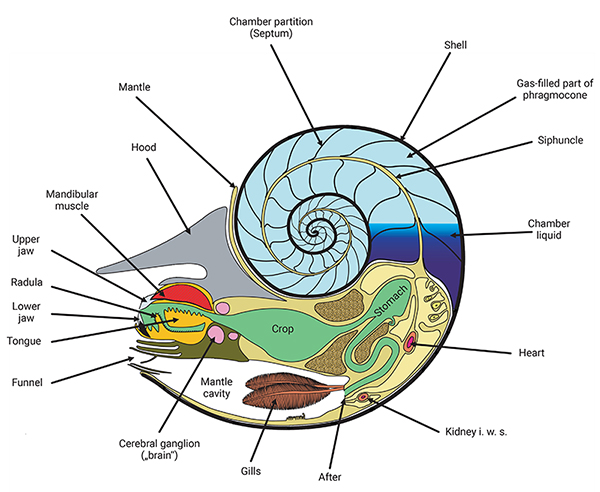
Figure 1: Bauplan of a cephalopod of the genus Nautilus. Modified from Griffin (1900) and Haszprunar & Götting (2007). Wikipedia Commons, Permission: cc-by-sa 4.0