March 2026: Mummified woolly mammoth skin with hair
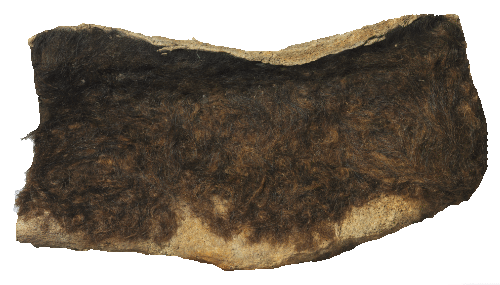
Mammuthus primigenius (Blumenbach, 1799)
BSPG 1995 I 41
Quaternary: Middle – Late Pleistocene, c. 750,000 – 11,700 years ago
Yakutia, north-eastern Siberia, Russia
Length c. 25 cm, width c. 12 cm
Mammoths are an extinct genus of the elephant family (Elephantidae) that originated in Africa around 6 million years ago and spread to Europe, Asia and North America. They are characterised by their impressive spiral-curved tusks, which can grow up to 4.9 metres long. A total of 10 species are currently classified in the genus Mammuthus.
Probably the most famous representative is the woolly mammoth Mammuthus primigenius, which was described by Johann Friedrich Blumenbach in 1799. It lived from the early Middle Pleistocene (approx. 750,000 years ago) to the Holocene, with the last populations living in isolation on islands and dying out only around 4,000 years ago. The species first appeared in north-eastern Siberia, migrated to Europe around 150,000 years ago and spread to North America via the Bering Strait around 100,000 years ago.
There are currently two competing theories about the extinction of woolly mammoths. According to the first, hunting by humans contributed to the extinction of the species. The second theory attributes the disappearance of these ice age giants to global warming at the end of the ice age, the spread of wet tundra and forests, and the associated loss of dry, open vegetation. Their preferred habitat, the so-called mammoth steppe, was probably lush, tree-free vegetation with numerous nutritious herbs.
Since the first published find in 1799, 18 more or less completely preserved individuals have been described from Russia, the USA and Canada alone. Thanks to mummification in the permafrost soil and the associated preservation of soft tissues, it is now possible to reconstruct the age, sex, diet, social behaviour and even the circumstances of death of individual animals.
M. primigenius reached a height of 2.7–3.5 m, comparable to modern elephants, but was more compact and stocky. It possessed characteristic anatomical and morphological features, including small ears, a short tail, broad soles of the feet, a hood-like extension on its trunk and an adipose hump, as well as physiological adaptations such as a special fat metabolism and decreased sensitivity to cold, which favoured its widespread distribution in the northern Holarctic. Woolly mammoths had a dense, three-layered coat up to 90 cm long, consisting of downy undercoat, longer intermediate or guard hairs, and outer hairs. The hairs grew insulated in the skin and had sebaceous glands. The dense coat formed a kind of ‘skirt’ that reached almost to the ground, covering the belly, sides and upper legs, and provided protection from the wind and insulation in the snow. The skin and fat layer also contributed to thermal insulation: at 27–30 mm, the skin was similar in thickness to that of modern elephants, but the fat layer, at up to 9 cm, was significantly thicker than that of modern elephants (approx. 4 cm).
Melanie Altner, Munich