January 2026: Tentaculits
Tentaculites sp.
Paleozoic: Lower Devonian, approximately 410 million years old
Chortkiv, Podolia, Ukraine
Tentaculits (class Tentaculita) belong to an enigmatic, now-extinct group of fossils that were widespread in the Paleozoic, particularly during the Silurian and Devonian periods. Their small, conical shells resemble tiny mollusc shells at first glance, but their systematic classification remains unclear. They are most likely worm-like animals related to the Lophophorata that lived in tubular calcareous shells. A recently published study (Vinn et al. 2025, Palaeoworld) suggests that the group shared a common ancestor with bryozoans.
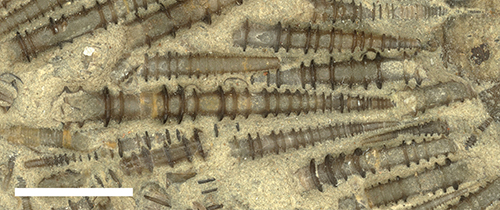
Close-up of the typical shells of Tentaculites sp. with clearly defined ribs. Scale bar: 5 mm.
Tentaculits were exceptionally abundant and cosmopolitan, especially during the middle Paleozoic. Fossils of this group are found on almost every continent. Stratigraphically, they first appear in the Cambrian and reach their greatest diversity in the Silurian and early Devonian periods. The order Tentaculitida, to which the specimen exhibited here belongs, disappears from the fossil record during the Late Devonian. Its diversity of forms ranges from hair-thin tubes to distinctly ornamented shells several centimetres long. The order comprises more than 150 described species.
The orders of tentaculits likely had different lifestyles. While species with thick shells lived predominantly benthically, i.e. on the seabed, other groups were found mainly as part of the plankton in the water column. Their shells probably served both as protection and as stabilization in the water. Some species are also thought to have lived endozoically, i.e. parasitically within other animals. The order Microconchida may also have occurred in fresh water. However, many theories about their lifestyle are speculative. What is certain is that tentaculits were important components of the marine ecosystems of the middle Paleozoic.
The shells of Tentaculites sp. exhibited here date from the Lower Devonian period and were deposited approximately 410 million years ago. The region around Chortkiv (Czortkow) was then located slightly south of the equator, on the western edge of a warm, shallow sea – the Rheic Ocean. The fossils show the typical slender, conical shells with clearly defined ribs, which presumably increased the shell’s stability.
Thomas A. Neubauer, Munich
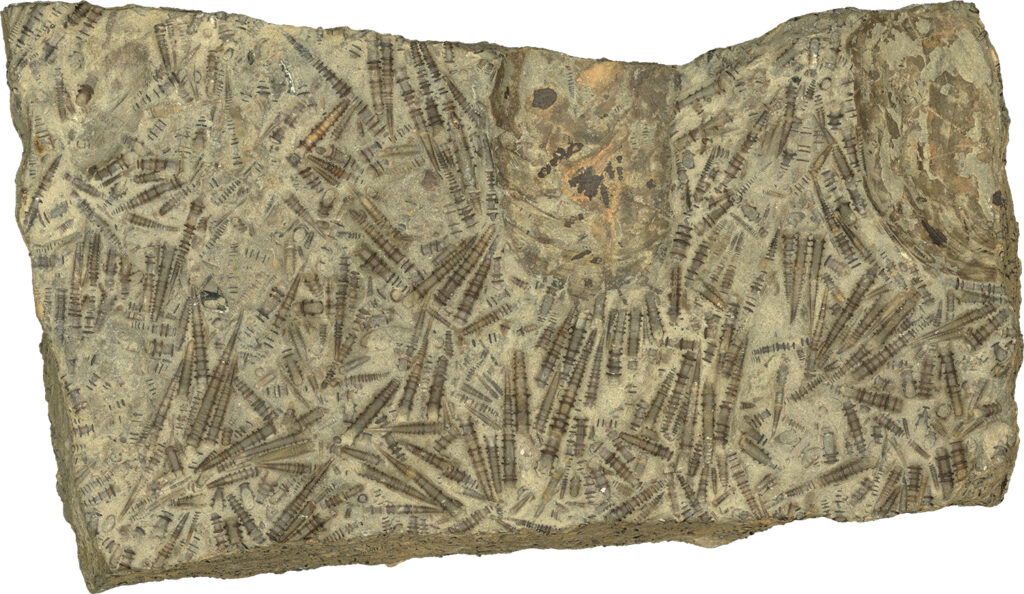
Tentaculites sp. from Lower Devonian deposits of Chortkiv in the Ternopil Oblast (Ukraine). Scale bar: 1 cm.