April 2026: Reconstruction of a predatory dinosaur skull – Irritator challengeri Martill et al.
SNSB-BSPG 2023 I 43
Early Cretaceous, c. 113 Ma
Ceará, Brazil
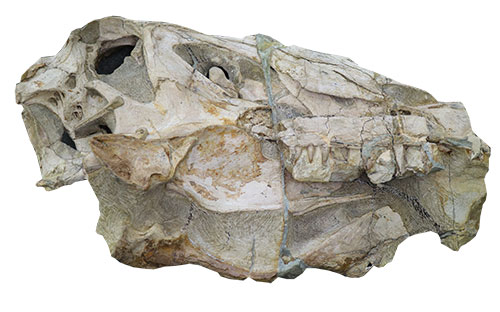
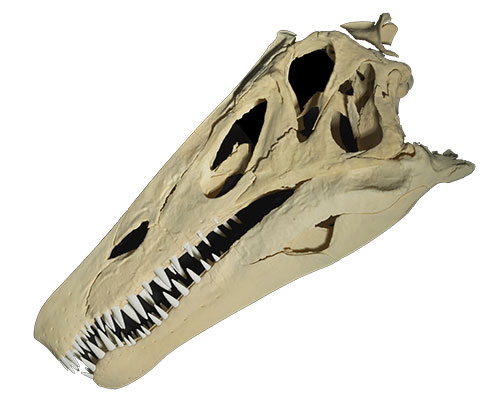
This “Fossil of the Month” is actually not a fossil at all, but a reconstruction of one. It is the skull of the predatory dinosaur Irritator, a medium-sized spinosaurid from the late Early Cretaceous of Brazil. This reconstruction illustrates how paleontological research is conducted today.
Spinosaurids were a group of medium-sized to gigantic predatory dinosaurs (theropods) that lived during the Cretaceous period, primarily in the continents of the Southern Hemisphere. Unfortunately, their fossil record remains extremely fragmentary; even the most famous representative, the gigantic Spinosaurus aegyptiacus from the early Late Cretaceous of Egypt, is known from less than 30% of the skeleton. Skulls, in particular, are rare. Only a lower jaw of Spinosaurus is known to date, and this was destroyed in World War II. Although various skull fragments from other sites in Africa have been assigned to the same taxon, these assignments are uncertain and controversial. The most completely known spinosaurid skull to date is that of Irritator challengeri, recovered from a rock nodule, missing only the tip of the snout and the front part of the lower jaw. However, the skull, as preserved, is partially disintegrated and compressed. Its preservation within the nodule also makes it difficult to study anything beyond the external surfaces of the bones.
Therefore, to examine the morphology of this scientifically significant skull in detail, it was scanned using computed tomography (CT). An initial scan was performed in a medical tomograph at the German Heart Center in Munich. Since the resolution of this tomograph, designed for human tissue, is insufficient for examining the fine details of a fossilized skull, a second scan, specifically of the braincase, was conducted using an industrial scanner at Zeiss in Essingen. The resulting CT data reveal both the external and internal structures of the skull in a series of cross-sectional images, which can be studied on a computer from various orientations. Careful graphical separation of the bony structures from the surrounding rock allows for the creation of digital 3D models of the individual bones. These models enable researchers to examine the structures from all sides and even look inside the bones. This not only facilitated a detailed description of the morphology of the skull of Irritator but also allowed for the reconstruction of its brain cavity and inner ear. This revealed that these large predatory dinosaurs likely did not hold their skulls horizontally, but rather with a distinctly downward-pointing snout, similar to modern-day storks. Furthermore, the resulting models can be supplemented with the missing bones, printed on a 3D printer, and assembled into an anatomically accurate reconstruction of the skull, providing a good impression of what these unusual predatory dinosaurs looked like.
Oliver Rauhut